Concrete Driveways in Mentor, OH
Concrete driveway installation in Mentor, OH with proper base prep, reinforcement options, and clean finishing. Built for durability, drainage, and curb appeal.
What to decide before we pour
- Thickness: Most driveways perform best when thickness matches load and subgrade (and edges are reinforced where tires track).
- Base depth: A properly compacted stone base is what keeps the slab supported and flat.
- Drainage & slope: We plan slope away from structures and prevent pooling that accelerates surface wear.
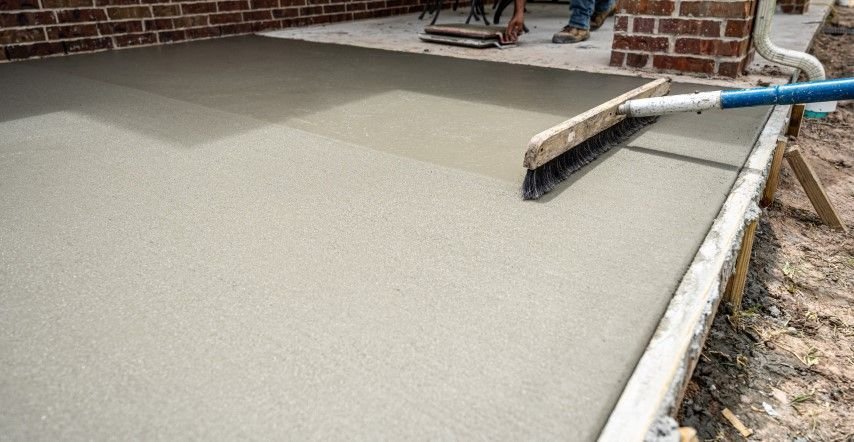
- Finish: Broom finish for traction, or decorative options for higher curb appeal.
- Joint plan: Control joints reduce random cracking and keep panels looking intentional.
Our installation approach
- Site evaluation — Measure, confirm slope/drainage, and mark edges/returns.
- Excavation + base — Remove unsuitable material, place and compact stone base.
- Forms + reinforcement — Set forms, install rebar/fiber plan, and protect edges.
- Pour + finish — Place concrete, finish to spec, cut/tooled joints.
- Curing — Controlled cure to reduce shrinkage cracking and strengthen surface.
How this service performs in Northeast Ohio
Driveways fail early when the base is weak, drainage is ignored, or the slab is undersized for vehicle loads.
We design driveways around how you actually use them—daily parking, turning tires, delivery trucks, and winter de‑icers—then build a base and slab thickness that can handle it.
If you’re replacing an old driveway, we’ll look for the root causes (settlement, poor slope, downspout discharge) so the new one doesn’t repeat the same issues.
Common problems we prevent
- Settlement from inadequate base or poor compaction.
- Pooling water that leads to scaling and ice issues.
- Random cracking from missing/poorly placed control joints.
- Edge breakdown from thin edges without reinforcement.
Cost drivers and what moves the number
We price with site realities in mind (grade, access, base prep, and finish level). Here’s what most impacts cost:
- Square footage and thickness requirements (vehicle load).
- Demolition and haul‑away of old concrete.
- Access for equipment and concrete truck placement.
- Base work needed (soft spots, drainage corrections).
- Finish level (standard broom vs decorative borders).
Tip: a slightly thicker slab and better base typically costs less long‑term than patching recurring cracks from settlement.
Typical timeline
| Phase | What happens | Typical time |
|---|---|---|
| Site prep | Layout, excavation, base compaction, forms, reinforcement | Half day – 2 days |
| Pour + finish | Placement, screed, finish, joints/texture | Same day |
| Cure window | Controlled curing to reduce shrinkage cracking | 3–7 days (walk), 7–14+ days (vehicles depending on design) |
FAQs
How long does a concrete driveway last?
With solid base prep, proper joints, and reasonable winter care, a quality driveway can last decades.
Will my driveway crack?
Concrete can crack, but we control where it happens with joint spacing and curing—reducing random cracks.
Can you widen or extend an existing driveway?
Yes. We match grades and plan joints so new work ties in cleanly.
What’s the best finish for traction?
A broom finish is the standard for safe traction in wet and winter conditions.
Ready to plan your project?
Get a straightforward recommendation—repair, replace, or upgrade.
Call and we’ll confirm scope, finish options, and the right thickness/reinforcement for your use case.